Cross Border Acquiring for Global Payment Scale
Cross border acquiring helps global merchants raise approval rates, control risk, and offer local payment choices without fragmenting payment operations.

A UK-issued card used on a casino platform licensed in Curaçao, processed through an acquirer in the EEA, is not just a card transaction. It is a decision about authorization routing, issuer trust, local regulation, FX exposure, fraud liability, settlement timing, and customer conversion. Cross border acquiring is the infrastructure discipline behind making that decision perform at scale.
For PSPs, merchant aggregators, iGaming operators, crypto platforms, forex brokers, and international marketplaces, acquiring strategy directly affects revenue. A single domestic acquiring relationship may be enough to launch. It is rarely enough to sustain approval rates and risk control as customer acquisition expands across markets.
What Cross Border Acquiring Actually Means
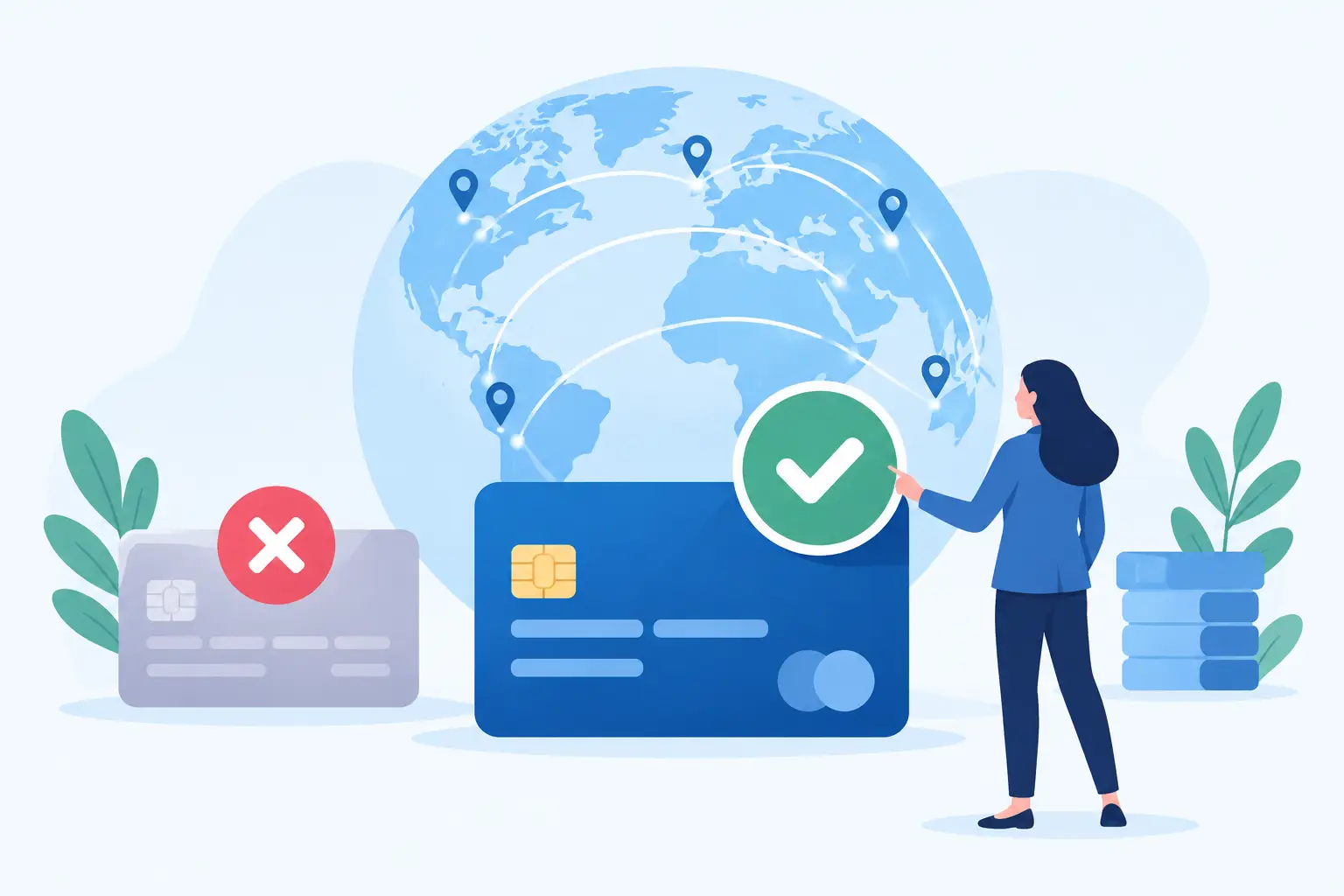
Cross border acquiring occurs when a merchant accepts a payment from a cardholder in one country through an acquiring entity located in another country. The merchant, acquirer, issuer, cardholder, and settlement account may all sit in different jurisdictions.
That structure is common in international digital commerce. A merchant may establish a legal entity in one market, operate in several others, and serve customers globally. The practical question is not whether cross-border transactions will happen. It is whether the payment stack can identify them, route them intelligently, price them correctly, and manage the resulting risk.
Card schemes permit cross-border processing within their rules, but issuers can treat foreign-acquired transactions differently from domestic ones. Depending on the payment corridor, an issuer may apply higher scrutiny, require stronger authentication, or decline a transaction that appears misaligned with a customer’s usual spending behavior. High-risk verticals face an additional layer of monitoring from acquirers, schemes, and regulators.
This is why cross-border acquiring should be treated as a performance function, not a procurement checkbox.
Why Local Acquiring Often Changes Approval Rates
Issuers generally have more context for transactions that look local. A domestic merchant descriptor, local currency, familiar acquiring route, and regionally expected authentication pattern can all reduce uncertainty during authorization. None guarantees approval. Together, they can improve the transaction profile presented to the issuer.
A local acquiring setup may also reduce avoidable friction for the customer. If a Brazilian customer sees a BRL amount and can pay through a preferred local method, the payment experience better matches how that market transacts. If the same customer is asked to complete an international card payment in USD, conversion and issuer acceptance may decline.
The commercial trade-off is complexity. Every additional acquirer creates another integration, agreement, fee structure, settlement cycle, reconciliation format, dispute process, and operational relationship. Adding local acquirers without orchestration simply moves the bottleneck from checkout to finance and operations.
The better model combines local access with centralized control. Merchants need the ability to use the acquirer best suited to a country, currency, card scheme, or risk profile while retaining one operational view of transactions, balances, chargebacks, payouts, and provider performance.
The Difference Between Local Presence and Local Performance
A local entity is not automatically a local payment strategy. Some markets require specific licensing, tax registration, data handling, or merchant-of-record structures before domestic acquiring is available. In others, local acquiring is technically possible but commercially unnecessary because international card acceptance already performs well.
The right decision depends on transaction volume, average ticket size, customer payment preferences, fraud levels, authorization data, settlement needs, and the merchant’s legal footprint. A high-volume operator in a strategic market may justify a direct local acquiring relationship. A new market with uncertain demand may be better served through a cross-border route first, with local expansion triggered by measurable performance thresholds.
Build Cross Border Acquiring Around Routing, Not One Provider
A global acquiring model becomes valuable when routing decisions are dynamic. Payment traffic should not be sent to a single provider by default just because that provider was integrated first.
Routing logic can evaluate issuer country, BIN data, payment currency, card scheme, transaction amount, merchant category, historical approval performance, provider availability, and fraud signals. It can then send the transaction to the provider with the strongest expected outcome under defined commercial and risk constraints.
For example, a European issuer card may perform best through an EEA acquirer with 3DS optimization, while a customer in Southeast Asia may convert better through a local wallet or bank-transfer rail. A transaction from a high-risk segment might require a route with stricter controls and lower chargeback tolerance, even if its headline processing rate is higher.
Smart routing is not a rule to maximize approvals at any cost. A route that authorizes more transactions but later produces excessive fraud, disputes, or reserve requirements can damage unit economics. The objective is profitable acceptance: approved payments that settle reliably and remain defensible after the sale.
Use Cascading Carefully
Cascading can recover revenue after a soft decline by attempting authorization through another eligible acquirer. It is useful, particularly where provider performance varies by issuer or geography. But it must be controlled.
Repeated retries can create duplicate authorizations, confuse customers, raise issuer suspicion, and violate scheme or acquirer expectations. The routing engine needs clear retry rules based on decline codes, time windows, transaction type, customer consent, and provider capabilities. Hard declines, suspected fraud, and authentication failures should not be blindly retried.
For recurring payments, account updater services, network tokens, intelligent retries, and localized payment alternatives can be more effective than simply sending the same credential through multiple routes.
Risk and Compliance Do Not Stop at the Checkout
Cross-border payment acceptance introduces overlapping obligations. Merchants must understand where they are selling, where they are acquiring, where funds settle, and which rules apply to customer verification, sanctions screening, data security, tax, gaming, consumer protection, and reporting.
The exact requirements vary by corridor and vertical. iGaming, crypto, and forex businesses should expect closer scrutiny of source-of-funds controls, transaction monitoring, responsible-gaming practices where applicable, chargeback patterns, and marketing jurisdiction restrictions. A payment route that appears commercially attractive can become unusable if merchant activity, licensing, or customer geography does not fit the acquirer’s risk appetite.
Chargeback management also needs to be centralized. Disputes arrive through different acquirers, often with different evidence windows and file formats. Without a unified case-management workflow, operations teams lose time gathering proof of authentication, customer activity, device intelligence, delivery, account history, and communications.
For digital high-risk businesses, prevention matters more than dispute recovery. Shared fraud intelligence, velocity controls, device and behavioral signals, 3DS strategy, negative lists, and transaction-level rules should inform routing before an authorization request leaves the platform.
Settlement, FX, and Reconciliation Are the Real Operating Test
A payment program can show strong authorization rates while creating a finance problem. Cross-border acquiring often means multiple settlement currencies, rolling reserves, provider fees, scheme fees, FX spreads, payout schedules, and funding delays.
Finance teams need visibility from authorization through settlement. That includes gross payment volume, approved volume, provider costs, fees, refunds, disputes, reserves, and net available balance by merchant, currency, legal entity, and provider. If these data points live in separate portals and spreadsheets, accurate margin analysis becomes slow and unreliable.
A centralized merchant operations environment should normalize provider data and make reconciliation traceable. Payment operations need to know why a transaction was routed, who processed it, what it cost, whether it settled, and whether it later became a refund or chargeback. Those answers should be available without manual investigation across disconnected systems.
FX should be managed as a commercial decision, not an afterthought. Displaying local currency can improve conversion, but the business must decide who bears conversion risk, which rate source applies, when rates are locked, and how settlement currency affects treasury. For some merchants, multi-currency settlement is essential. For others, consolidating settlement into one base currency is worth a controlled FX cost.
A Practical Architecture for Global Acquiring
The strongest model separates payment acceptance from individual provider dependencies. A single API layer connects acquirers, PSPs, wallets, bank-transfer rails, and crypto payment options. An orchestration layer applies routing, retries, fraud rules, and fallback logic. A merchant layer manages onboarding, pricing, balances, settlements, reporting, and support workflows.
This is where white-label infrastructure has strategic value. Rather than building provider integrations, merchant administration, ledger workflows, risk controls, and monitoring tools internally, a PSP or payment business can launch its own branded operating environment while preserving control over commercial relationships and route design.
ZepoPay is built for this operating model, combining 75+ providers and more than 250 payment methods through one API and a deployable white-label platform. For businesses entering multiple regions, the objective is not to add providers for appearance. It is to create a payment network that can adapt as approval data, regulation, and customer behavior change.
Measure the Metrics That Reveal Route Quality
Approval rate is necessary but incomplete. Track authorization performance by issuer country, BIN range, payment method, currency, provider, customer segment, and transaction type. Compare that data against fraud rate, chargeback rate, refund rate, processing cost, reserve impact, and settlement speed.
A route should earn more volume when it produces better net outcomes, not simply more initial approvals. Equally, a provider should not be removed after a short performance dip without checking for seasonality, issuer outages, customer mix shifts, or an authentication configuration issue.
Set operating thresholds before expansion. Define the volume, decline rate, cost level, and customer demand that justify adding a local acquirer or payment method in a market. This keeps international growth tied to evidence rather than assumptions.
Global acceptance works best when each transaction is treated as a routeable, measurable decision. Build the control layer first, then let the acquiring network expand where the data proves it should.